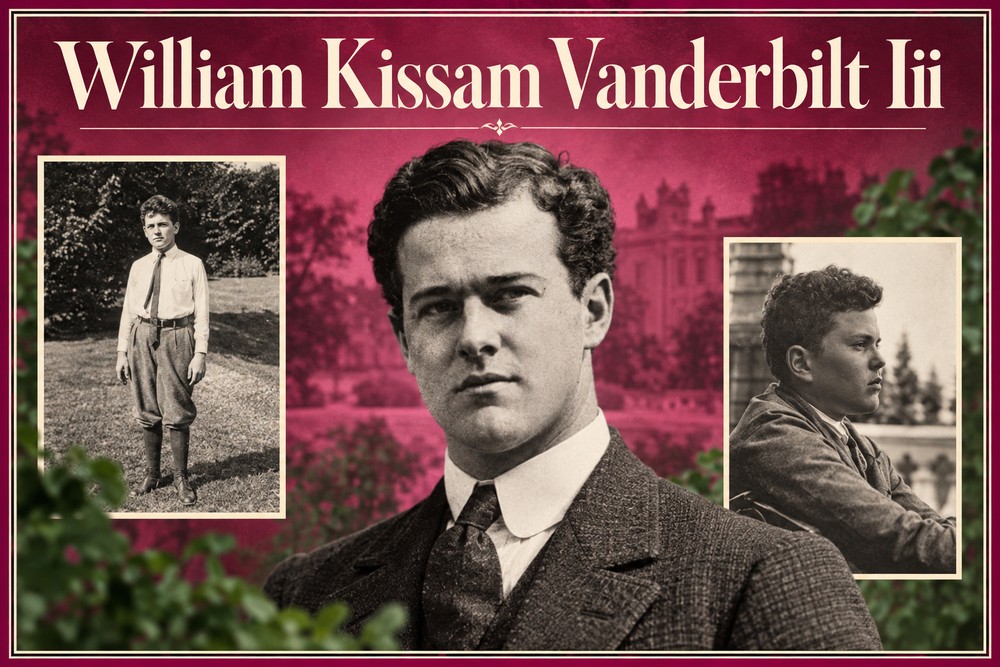
Basic Information
| Field | Detail |
|---|---|
| Full name | William Kissam Vanderbilt III |
| Commonly styled | William K. Vanderbilt III, Willie K. III |
| Birth | 26 October 1907 |
| Place of birth | New York City, New York |
| Death | 15 November 1933 |
| Place of death | Near Ridgeland, Jasper County, South Carolina |
| Cause of death | Injuries from an automobile collision with a parked fruit truck |
| Age at death | 26 |
| Parents | William Kissam Vanderbilt II and Virginia Graham Fair |
| Siblings | Muriel Vanderbilt, Consuelo Vanderbilt |
| Marital status | Unmarried |
| Children | None recorded |
| Public profile | Heir, traveler, hunter, and motoring enthusiast |
| Associated residences | Vanderbilt family homes in New York and the Eagle’s Nest estate, Centerport, Long Island |
| Memorial | A memorial wing established by his father at the Suffolk County Vanderbilt Museum at Eagle’s Nest |
Early Life and Lineage
William Kissam Vanderbilt III was born into two American dynasties. His paternal family stretched through Gilded Age New York from William Henry Vanderbilt to Cornelius Vanderbilt, the Commodore who transformed the American economy with steamships and railroads. His maternal family led to Comstock Lode silver tycoon James Graham Fair, whose Nevada fortune poured into hotels, philanthropy, and both coasts’ social centers.
As the grandson of William Kissam Vanderbilt and the son of the famous sportsman William K. Vanderbilt II, Willie K. III grew up in stables, salons, ocean yachts, and Fifth Avenue parlors. His mother, Virginia Graham Fair, brought West Coast confidence and her own fortune into the family. Marriage united East and West, steel railroads and silver mining, ancient and new money. It influenced the childhood of a boy expecting to inherit a lifestyle, not a career.
A Youth in Motion: Automobiles, Travel, and Sport
Speed attracts certain kids, and Willie K. III felt its music early. He spent time in Paris and London in the 1920s and 1930s, in addition to the family’s Long Island home. Hunting, collecting, touring, and driving, he chased horizons like young cosmopolitans between the wars.
Autos were family trademarks. His father favored motorsports, seafaring, and road trips. Son followed that spark. Later photos and family displays depicted a life full with cars, awards, and travel mementos. He never pursued business. The globe was his playground, and travel his classroom.
The Family Constellation
Every Vanderbilt generation produced figures who were both larger than life and tightly bound to one another. Willie K. III belonged to a particularly visible branch whose members spanned boardrooms, regattas, and grand tours. The table below sketches the immediate constellation around him.
| Name | Lifespan | Relationship to William K. Vanderbilt III | Notes |
|---|---|---|---|
| William Kissam Vanderbilt II | 1878-1944 | Father | Sportsman, yachtsman, motor racing patron, creator of the Eagle’s Nest estate and museum |
| Virginia Graham Fair | 1875-1935 | Mother | Heiress and philanthropist, daughter of mining magnate James G. Fair |
| Muriel Vanderbilt | 1900-1972 | Sister | Socialite with multiple marriages, active in society life |
| Consuelo Vanderbilt | 1903-2011 | Sister | Social figure and renowned dog breeder, later known as Consuelo Vanderbilt Earl |
| William Kissam Vanderbilt | 1849-1920 | Paternal grandfather | Gilded Age philanthropist and horse breeder |
| William Henry Vanderbilt | 1821-1885 | Paternal great-grandfather | Railroad magnate who expanded the family fortune |
| Cornelius Vanderbilt | 1794-1877 | Paternal great-great-grandfather | The Commodore, founder of the house of Vanderbilt |
| James Graham Fair | 1831-1894 | Maternal grandfather | Comstock Lode silver magnate, United States Senator |
| Theresa Rooney Fair | 1837-1922 | Maternal grandmother | Matriarch of the Fair family line |
| Harold Stirling Vanderbilt | 1884-1970 | Paternal uncle | Champion yachtsman and rules architect for international sailing |
Wealth, Expectation, and the Problem of Purpose
By Willie K. III’s maturity, the family fortune had shifted from railroads and real estate to trusts and philanthropy. This guaranteed riches and public attention for a 1920s scion. Wealth can be a stage or shelter. His brief life followed many in his circle: vast travel, sporting experience, and a light press footprint outside of society pages. His record included no elected offices or notable businesses. He looked satisfied to travel at his own pace.
The 1933 Crash and Its Echo
Willie K. III hit a fruit truck near Ridgeland on November 15, 1933, while driving through South Carolina. Whether he drove or rode with a driver has been contested in family and regional legends. Undisputed is the outcome. He died at 26 from injuries.
The news spread quickly. A young man known for motion met an immovable object on a Southern roadside one evening. Speed, surprise, and steel ended a potential life in seconds. The family was hurt beyond the headlines. Grief became architecture in subsequent months.
Eagle’s Nest and the Afterlife of Memory
William K. Vanderbilt II built a memorial for his son at Eagle’s Nest, his hilltop estate overlooking Northport Bay and personal museum of natural history and travel, two years after the tragedy. Medals and travel items from the younger man’s pursuits were in the memorial wing. It joined exhibits of marine specimens and anthropological items from the elder Vanderbilt’s journeys, linking father and son in discovery.
Today the Suffolk County Vanderbilt Museum stands as a palimpsest of the family’s interests. Boats and engines, birds and butterflies, carvings and maps. Among them, the memory of Willie K. III persists as an emblem of youth and velocity, a spark preserved in glass.
Timeline of Key Dates
| Date | Event |
|---|---|
| 26 Oct 1907 | Birth in New York City |
| 1899 | Parents married, joining Vanderbilt and Fair family fortunes |
| 1900-1903 | Sisters Muriel and Consuelo born |
| 1920-1933 | Young adulthood marked by travel, motoring, and sport |
| 15 Nov 1933 | Fatal automobile collision near Ridgeland, South Carolina |
| 1935 | Memorial wing dedicated to William K. Vanderbilt III at Eagle’s Nest |
People and Places: A Quick Map
- New York City: Birthplace and family center for Vanderbilt philanthropy.
- Centerport, Long Island: Site of Eagle’s Nest, later the Suffolk County Vanderbilt Museum.
- Paris and London: Period residencies that reflected a transatlantic social life in the 1920s.
- Ridgeland, South Carolina: Location of the 1933 motor collision.
Legacy and Lineage in Perspective
To weigh 26 years is to consider facets, not chapters. Willie K. III came from a dynasty known for large homes and projects. In smaller keys, his legacy lives. Trophy cabinet. A museum wing where a father preserved his son’s interests. Family trees tell the structural tale, while rooms filled of items reveal the heartbeat. His family and motion frame him as a young guy traveling swiftly in the Vanderbilt shadow.
FAQ
Was William K. Vanderbilt III ever married
No. There is no record of a marriage or children.
How did he die
He died from injuries sustained when his car struck a parked fruit truck near Ridgeland, South Carolina, on 15 November 1933.
Who were his parents
He was the son of William K. Vanderbilt II and Virginia Graham Fair.
Did he have a public career
No. He did not establish a significant business or public career before his death at 26.
Where is he memorialized
His father established a memorial wing in his honor at the Eagle’s Nest estate, now part of the Suffolk County Vanderbilt Museum.
Who were his siblings
His sisters were Muriel Vanderbilt and Consuelo Vanderbilt, the latter living to 2011.